Cramming compresses a span of text into a single learnable memory embedding: we freeze a pretrained LM and optimise one input vector $\mathbf{e}$ by gradient descent until the frozen model reconstructs the original tokens from it. Progressive cramming grows the target span one token at a time, advancing only after the current span reconstructs exactly — yielding an honest, per-sample compression horizon with 100% greedy reconstruction. We find horizons of hundreds-to-thousands of tokens across model families, that the optimisation trajectories are intrinsically low-dimensional, and a sharp caveat: reconstruction ≠ understanding — prepending a perfectly crammed embedding drops downstream accuracy and collapses generative MMLU to ~0%.
The method
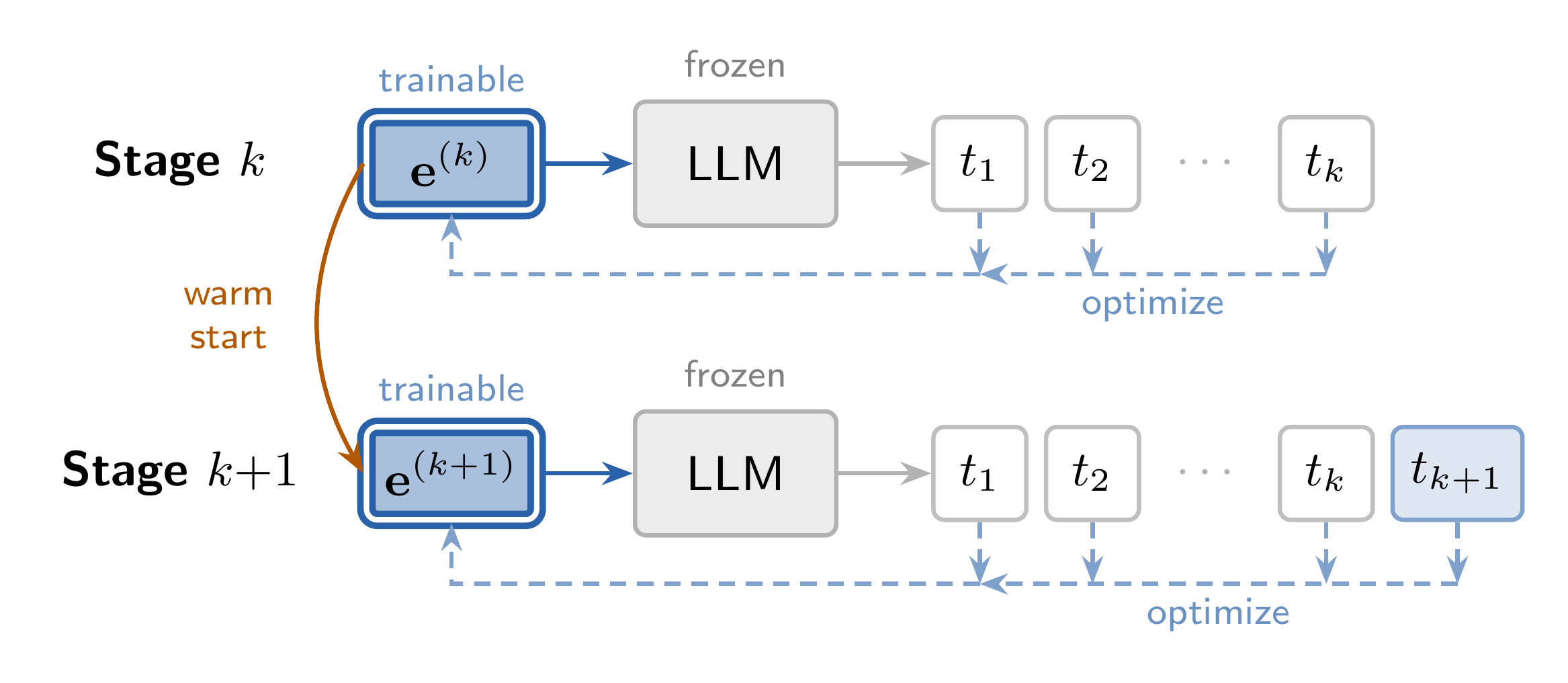
A frozen LM and one trainable input embedding, optimised per text — grown one token at a time.
Progressive cramming --progressive_train
Grow the target span one token at a time, warm-starting the embedding between stages and advancing only on exact reconstruction. Halting at the first failure gives a sharp, honest per-sample capacity boundary — the compression horizon — with 100% greedy reconstruction (unlike full cramming, whose ~99% teacher-forced accuracy still derails under greedy decoding).
How much fits in one embedding
Maximum prefix a frozen model reconstructs exactly from a single embedding via progressive cramming — and the boost from optimising inside a low-dimensional subspace.
| Model | Compressed tokens | + Low-dim projection | Boost |
|---|---|---|---|
| Llama-3.1-8B | 1438 | 1697 | 1.2× |
| Pythia-1.4B | 430 | 500 | 1.2× |
| SmolLM2-1.7B | 335 | 957 | 2.9× |
| Gemma-3-4B | 214 | 697 | 3.3× |
Tokens = longest prefix reconstructed exactly (mean over 50 PG-19 samples). Low-dim uses
$k=256$ (Gemma $k=32$). These are the runs behind the paper's progressive_modifications table —
step through them in the explorer below, or download the full per-stage trajectories
from Hugging Face.
Trajectories are low-dimensional
30–100 PCA components capture 99% of the variance of an entire cramming trajectory, and the count grows only ~logarithmically with sequence length. The same warm-started optimisation also leaves a per-token fingerprint: harder (higher-surprisal) tokens take more optimiser steps to absorb — exactly what the explorer visualises.
Reconstruction ≠ understanding
A perfectly crammed embedding stores enough to regenerate the text — but almost nothing the model can use. Prepending it drops benchmark accuracy, even with the original prefix still in context.
| Model | HellaSwag base | HellaSwag + emb | ARC base | ARC + emb |
|---|---|---|---|---|
| Pythia-1.4B | 44.0% | 37.6% | 53.1% | 49.1% |
| SmolLM2-1.7B | 53.6% | 37.0% | 67.3% | 56.0% |
| Llama-3.1-8B | 61.9% | 40.8% | 63.5% | 43.3% |
Likelihood evaluation: a candidate suffix is scored by NLL given [crammed embedding · prefix · suffix]. On generative 5-shot MMLU the effect is starker — accuracy collapses to ~0% with the optimised embedding, while a random-vector control stays at baseline. The information is present but acts as brittle steering, not transferable semantics. Attention-knockout analysis traces both reconstruction and capability collapse to the model's early layers.
Interactive per-token explorer
Step through a real cramming run token by token. Drag the horizon slider to watch the frozen model absorb the prefix one token at a time; hover any token for its surprisal and the optimiser steps it cost. Notice how high-surprisal tokens spike the step cost — and where the horizon hits a wall.
Surprisal $s(L)=-\log_2 p(x_L\mid x_{\lt L})$ is the frozen base model's per-token difficulty (bits);
steps-to-converge is the marginal optimiser cost of absorbing that token. Data is exported offline from the
progressive_modifications runs (one frozen forward pass per sample for surprisal; steps read from
each run's per-stage dataset) — the full per-stage trajectories are published on
Hugging Face.
Citation
@inproceedings{tarasov2026progressive,
  title     = {Progressive Cramming: Reliable Token Compression and What It Reveals},
  author    = {Tarasov, Dmitrii and Lashukov, Timofei and Goncharova, Elena and Kuznetsov, Andrey},
  booktitle = {Proceedings of the International Conference on Machine Learning (ICML)},
  year      = {2026}
}
Reference implementation, quickstart, and full reproduction recipe: github.com/FusionBrainLab/progressive_cramming. Builds on the cramming task of Kuratov et al. (2025).